
What are Cutting Blades and their Processing Advantages

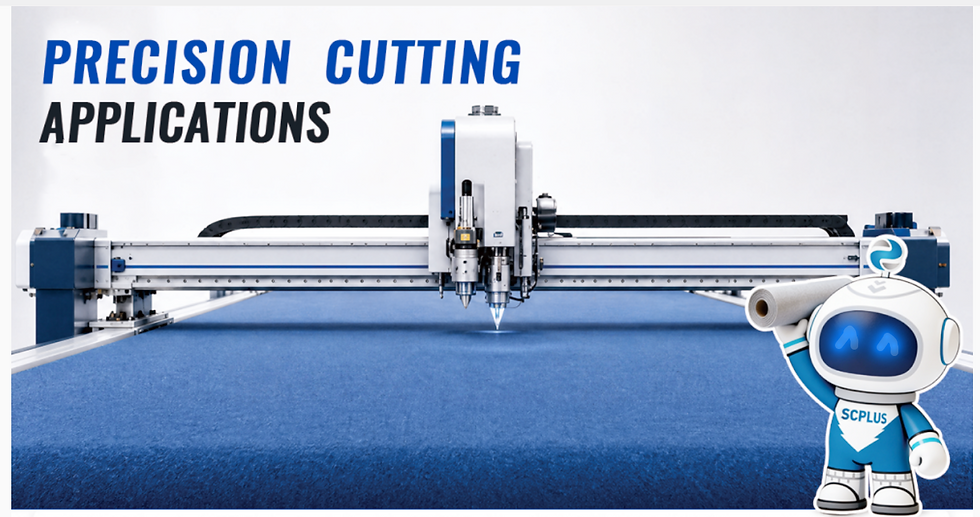
With the rapid pace of modernization, market demands for personalization are constantly increasing. Faced with a range of new materials and diverse consumer needs, many intelligent digital cutting devices have emerged, especially flatbed digital cutters, which are increasingly widely used for processing flexible materials. Besides laser cutting equipment, vibrating blade cutting machines equipped with high-performance cutting blades are also attracting significant industry attention. SCplus Belt provides a detailed analysis of cutting blades.

What is a Cutting Blade
A vibrating blade is a new type of cutting process. Its principle is to complete the cut by the high-speed up-and-down vibration of the blade. Compared with traditional blade cutting, vibrating blades offer faster cutting speeds, smoother cuts, and can be integrated with intelligent control systems to achieve high-precision automated processing.
In modern flatbed digital cutters, vibrating blades are typically used in combination with various cutting blade modules, enabling rapid switching between different materials. This is a key reason why brands such as Esko, Zünd, Summa, Aristo, and Comelz widely adopt this technology.
Applications of Vibrating Cutters:
Fabrics
Leather
Foam Board
PVC
KT Board
Corrugated Paper
Composite Materials
Widely used in:
Advertising Packaging, Garment Sampling, Digital Printing, Automotive Interiors, Upholstered Furniture, Bags & Shoes, and other industries.
In these industries, high-quality cutting blades are crucial to achieving high-quality cutting. Different brands of digital cutters have different blade specifications, for example:
Esko cutting blades
Zünd cutting blades
Summa cutting blades
Aristo cutting blades
Comelz cutting blades
Blades matching the original manufacturer's blade parameters ensure cutting accuracy, extend tool life, and improve production efficiency.
What is Vibrating Cutter Amplitude?
Vibrating cutter amplitude refers to the displacement range of the blade's up-and-down vibration. It usually needs to be adjusted based on the material thickness, and its parameters are closely related to the cutting blade's structure, length, and hardness.
Vibratory cutters can be categorized by their drive mechanism:
Pneumatic Vibratory Cutters
* Large amplitude (up to approximately 10mm)
* Suitable for thick and highly elastic materials
* Commonly used for foam, sponge, etc.
Electric Vibratory Cutters
* Smaller amplitude (1–3mm)
* Higher frequency (up to 20,000 times/minute or more)
* Suitable for medium to thin materials such as PVC, corrugated paper, and KT board.
Different cutter types determine the processing direction:
* Amplitude → Determines the thickness that can be cut
* Frequency → Affects cutting speed and material hardness compatibility
In modern flatbed digital cutters, processing techniques can be quickly switched by changing different types of cutting blades.
Advantages of Vibratory Cutting Compared to Laser Cutting
In flexible material processing, vibratory cutting is a cold cutting method, offering significant advantages over laser cutting:
✅ No High Temperatures
No burning, scorching, or material damage.
✅ Clean Cuts
No melting, no smoke, no odor.
✅ Multi-Layer Cutting Capable
For example, leather and fabric can be layered for processing, improving efficiency.
✅ More Environmentally Friendly
No dust or heat-affected zone.
✅ Interchangeable Cutting Blades
By changing different cutting blades, various processes such as circular cutters, drag cutters, half cutters, beveling cutters, and milling cutters can be achieved.
This is why digital cutter equipment from Esko, Zünd, Summa, Aristo, and Comelz prioritizes vibratory cutting technology in packaging prototyping and flexible material processing.
Intelligent Machining Advantages of Vibratory Cutting Systems
Modern flatbed digital cutters typically integrate multiple tool modules:
* Vibratory cutter
* Circular cutter
* Milling cutter
* Pressure roller
* V-cutting cutter
* Punching tool
* MARK vision positioning system
In conjunction with a tool-following control system, the following can be achieved:
✔ High-speed automated machining
✔ Dual-head asynchronous collaborative cutting
✔ Large-format vision-guided cutting
✔ Projection-assisted cutting
High-quality cutting blades are the core consumables ensuring the stable operation of these functions.
Application Industries of Vibratory Cutters
Vibratory cutters are mainly used in non-metallic cutting fields: Clothing sampling, sofa upholstery, digital printing, advertising packaging, curtain fabrics, bags, shoemaking, etc.
Especially when using digital cutters such as Esko, Zünd, Summa, Aristo, and Comelz for sampling and small-batch production, matching dedicated cutting blades can significantly improve cutting quality and production efficiency.
Vibratory cutting is a highly efficient, environmentally friendly cold-cutting technology, particularly suitable for processing flexible and semi-rigid materials.
Compared to laser cutting:
* No burnt edges
* Multi-layer cutting capability
* Lower cost
* Replaceable tools
* Flexible processing
In modern flatbed digital cutter systems, the combination of a vibrating blade and high-precision cutting blades has become a core configuration for equipment from brands such as Esko, Zünd, Summa, Aristo, and Comelz.
When selecting a cutting tool, the appropriate tool type and blade specifications should be chosen based on a careful consideration of material type, thickness, edge quality requirements, and cost to achieve the best processing results.


Comments